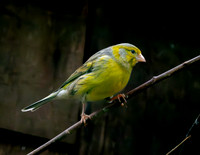
The Spanish Timbrado canary (Serinus canaria domestica) name originates from the Spanish word timbrado, which describes its unique, metallic, bell-like song with 12 distinct notes, mimicking Spanish castanets. A domestic canary, its natural habitat and distribution are linked to its wild ancestor the Atlantic canary (Serinus canaria), which is native to the Macaronesian islands in the eastern Atlantic Ocean, and prefers pine and laurel forests as well as gardens and farmland. The canary bird is named after the Canary Islands (Canariae Insulae), meaning "Islands of the Dogs," from the Latin canis (dog), due to large dogs found there by ancient explorers, and the islands were named after these dogs (or possibly a native tribe called the Canarii), not the other way around. Spanish sailors brought the birds (the wild Atlantic canary, Serinus canaria) to Europe, where they were bred for their song, and the bright yellow variety developed from mutations, leading to the color "canary yellow" named after the bird.


© BirdsImageStock