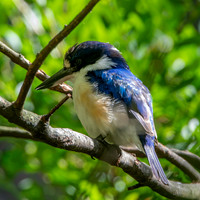
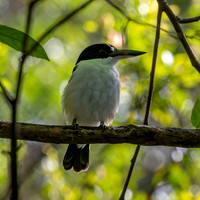
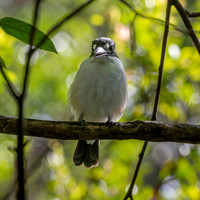
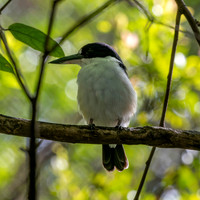
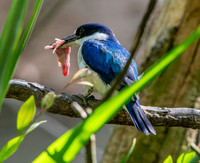
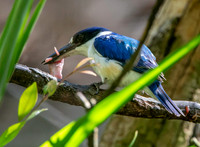
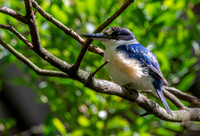
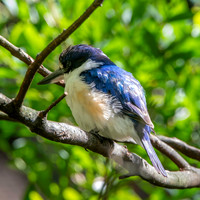
Most kingfishers that rely on rivers for food, but the forest kingfisher (Todiramphus macleayii) is named for its preferred woodland and forest habitat – it is a terrestrial hunter, swooping from low branches to catch spiders, beetles, grasshoppers, worms, and small lizards. Its scientific name honours Alexander Macleay (1767–1848), a Scottish entomologist and Colonial Secretary to New South Wales, who helped shape early Australian biological history. A brilliant blue and white bird native to Australia, forest kingfishers carve their nesting chambers directly into active, arboreal (tree-dwelling) termite nests. Males have a bright, solid white patch on the back of their neck (nape), while females have a blue patch. It thrives in the subtropical and tropical dry forests of eastern Australia, New Guinea, Indonesia, and the Solomon Islands.
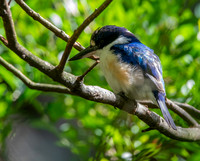
© BirdsImageStock