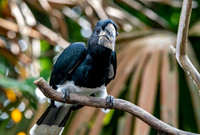
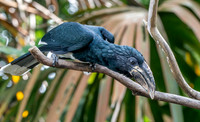
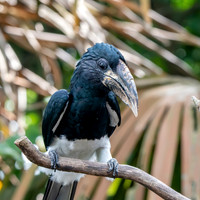
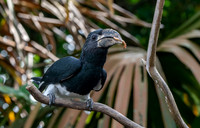
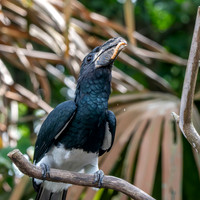
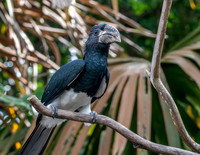
Primarily black, with white patches on its wings, tail, and belly, the black-and-white-casqued hornbill (Bycanistes subcylindricus) is a large, social African bird known for its distinct, booming call, large cashew-shaped casque, and unique nesting habits. Females seal themselves into tree cavities for up to three months to raise chicks, using mud and feces to block the entrance, leaving only a small slot for the male to pass food. Sometimes called the grey-cheeked hornbill due to the greyish patch on its face, it has long, stiffened feathers that act as eyelashes to protect their eyes from foraging debris. This hornbill favours evergreen, riparian, and moist secondary forests across Central and Western Africa, from Ivory Coast to Kenya. Thriving in high-canopy tropical forests up to 2,600 m, it is often found in pairs searching for fruit.
© BirdsImageStock