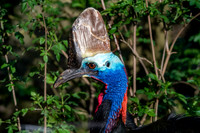
See: Southern Cassowary, Northern Cassowary
The name cassowary comes from two Papuan words, ‘kasu’ meaning horned and ‘weri’ meaning head, referring to the prominent casque on its head. It is a large species of flight-less bird, that is natively found in the forests of Papua New Guinea and on it's surrounding islands. The cassowary is closely related to other large flight-less birds including emus and ostriches and is the third tallest and second heaviest bird in the world behind these two. There are three species of cassowary which are the Southern Cassowary or Double-wattled Cassowary, found in southern New Guinea, northeastern Australia, and the Aru Islands, the Dwarf Cassowary or Bennett's Cassowary, found in New Guinea, New Britain, and on Yapen, and the Northern Cassowary or Single-wattled Cassowary, found in northern and western New Guinea, and Yapen. The main difference between nothern and southern are:
the number of wattles: the northern has one and the southern cassowary has two.
neck colouration - the northern cassowary often has a large orange, red, yellow, or blue patch on its lower neck, while the southern cassowary has a more extensive blue color down the neck