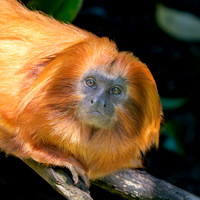
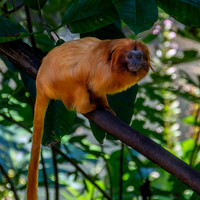
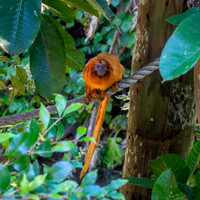
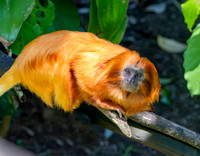
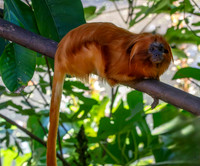
A small, endangered monkey native to Brazil, the golden lion tamarin (Leontopithecus rosalia) gets its name from its vibrant, reddish-gold fur and the thick ring of hair framing its face, which strongly resembles a lion's mane. First documented by European explorers in the 16th century, its scientific name combines the Greek words for "lion" (leon) and "monkey" (pithekos). It has a tail that is not prehensile, meaning it cannot grab objects, but it is longer than its body and used for balance. Mothers almost always give birth to twins and fathers do a large share of the child-rearing, carrying the heavy babies on their backs most of the day except when it is time to nurse.Numbers dropped in the 1970s to fewer than 200 in the wild due to forest loss. Thanks to Save the Golden Lion Tamarin and global zoo programs, protected wild populations have grown to over 3,000. They inhabit the Atlantic coastal forests of southeastern Brazil.

© BirdsImageStock