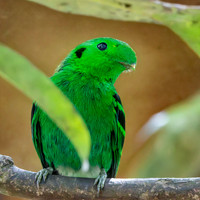
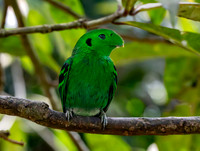
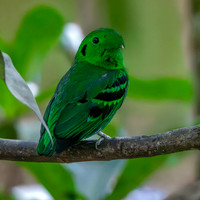
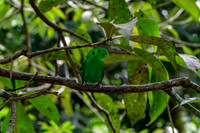
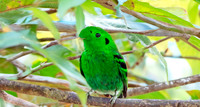
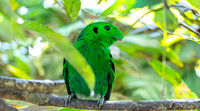
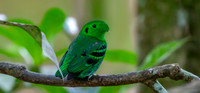
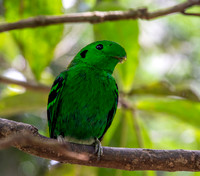
The near threatened Green Broadbill (Calyptomena viridis) is named for its vibrant green, camouflaged plumage and its broad, stout bill. "Calyptomena" comes from Greek, meaning "covered-mouth," referring to feathers that partially cover its beak, while viridis is Latin for green. A small, highly camouflaged fruit-eater native to Southeast Asian rainforests, it is notoriously hard to spot because it sits motionless in the canopy, blending in with the green foliage. Males have a vibrant green colour, a black spot behind each ear, and black bars on their wings, while females are duller and lack the black markings. Both sexes have large, deep black eyes. It feeds mostly on soft figs, with a mouth adapted to swallowing small, round fruits whole. Found on the Malay Peninsula, Sumatra, Borneo, and Mentawai Islands, it primarily inhabits lowland and hill rainforests.
© BirdsImageStock