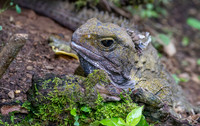
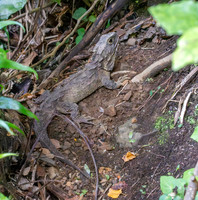
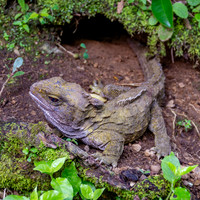
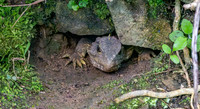
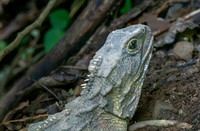
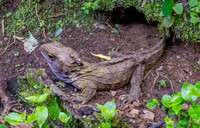
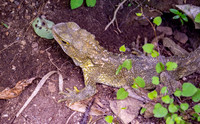
The tuatara (Sphenodon) is a rare, ancient reptile endemic to New Zealand. Though they look like lizards, they belong to a completely separate, ancient lineage – the last living survivor of the order Rhynchocephalia, a lineage that evolved 250 million years ago, predating the dinosaurs. They take up to 30 to 35 years to reach full size, and can live for 100 years or more. Female tuataras only lay eggs once every four years. Young tuataras have a visible parietal eye on top of their head complete with a lens and retina. It gets covered by scales as they age and is used to sense light cycles, helping regulate body temperature and daily/seasonal rhythms. They live in underground burrows and often share them peacefully with seabirds, even cohabitating in harmony. Unlike most reptiles that love the heat, tuataras thrive in cool weather and stay active at temperatures as low as 5°C (41°F) – in fact, they have the slowest metabolism of any reptile. Consequently, they can go up to an hour without taking a single breath.
© BirdsImageStock